
In Memoriam: 2000 - 2010
-
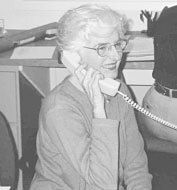 Laura Singleton
February 4, 2002
Fred Collins, a past President of Houston Audubon, eulogized Laura Singleton as the consummate soldier in "Audubon's Army" for her decades of service to Houston Audubon as a Board member and a volunteer. Among her many activities for Houston Audubon, Laura organized the Birdathon and ran the Speakers Bureau, planned and executed the first auctions, and chaired the silent auctions for Award Dinners. She was a regular at High Island from the beginning, helping with the organization and fundraising that made that critical sanctuary a reality. Laura was recipient of Houston Audubon's "Exceptional Volunteer Award" in 1998 for her years of dedicated volunteerism. At her memorial service in 2002, Jeff Mundy, who was the Houston Audubon President at the time, announced that the Exceptional Volunteer Award in the future would be known as the "Laura Singleton Exceptional Volunteer Award."Laura was a tireless worker, cheerful booster, and best arm-twister in the Society. With charming bulldog tenacity, she was able to cajole countless merchants into donating items for Houston Audubon auctions, and she wheedled volunteers into helping out at High Island year after year. Everyone knew that when Laura called, it was going to be impossible to turn her down, so people gave in the spirit that she asked – with enthusiasm and good humor.
-
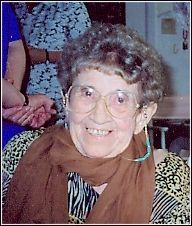 Bessie Cornelius
June 15, 2003
Most of us remember "Miss Bessie" as indefatigable fundraiser and guardian at the gate of our High Island sanctuaries, but many may not realize that Bessie and her fellow members of the East Texas Nature Club were the ones who "discovered" High Island. Fellow ETNC member Cora Hooks invited them there to bird on her property in the 1960's, and the history of the High Island sanctuaries began. Even before that, though, Bessie led an active life in conservation, involving herself in conservation projects wherever she lived. Her early work as a clerk in the Federal Court of the Northern District of Iowa, and various positions in the legal field that she held during a long professional life, prepared her ably for full-time activism in her retirement. Houston Audubon and other conservation groups have been the beneficiaries.As for birding, Bessie learned from her father, a self-taught naturalist, and the popular colored bird cards found in Arm & Hammer baking soda boxes at that time. Now coveted collectors' items, the cards were painted by Louis Agassiz Fuertes and had information on the back of the cards about the featured birds. It wasn't until she graduated from high school in 1926 in Lake Benton, Minnesota, though, that she had the experience of looking through a pair of binoculars. They were lent to her and a school friend by the friend's father, and they provided Bessie with her first bird through binoculars - a Northern Flicker.
It was a number of years before she owned her own binoculars, but by 1960, when she joined the East Texas Nature Club, she was a full-fledged birder. One of the more interesting birding events in her life was her involvement in 1967 in a team led by ornithologist John Dennis in search of the Ivory-billed Woodpecker. That effort led to an unconfirmed sighting by Dennis on the Neches River and the opportunity for Bessie to meet James Tanner, famous even then for his study of Ivory-bills. Membership and active participation in Houston's Outdoor Nature Club/Ornithology Group and Houston Audubon followed. Her role in publicizing, fundraising, and daily volunteerism at High Island are legendary. For years she was at Boy Scout Woods every day during migration to meet and greet (and collect money from) visitors to the High Island sanctuaries. Bessie is an inspiration to all who carry the High Island torch for her.
-
 Herb Orwig
January 29, 2004
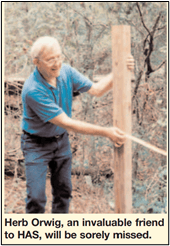
Herb Orwig's passing marked the loss of one of the pioneer volunteers who made possible the organization we have today. Not widely known among HAS members, Herb served Houston Audubon "inside" as an accountant and bookkeeper and outside as the first volunteer to join what is today’s trail work crew.A native of Oklahoma with a characteristic western drawl, Herb retired as the financial officer of a company in the oil industry. Former HA Executive Director Sandi Hoover recalls, "He just appeared at Edith L. Moore Sanctuary one day, probably in early 1987 and asked, ‘Kin I he'p ya?’. When I found out he had accounting experience, I almost didn't let him go home that day."
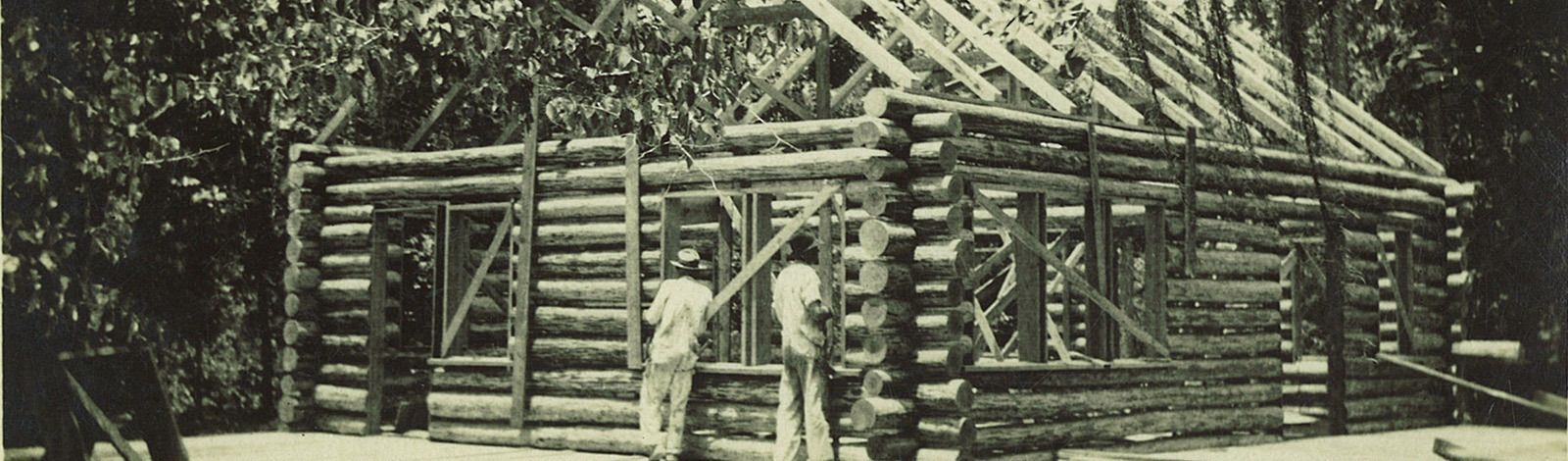
In those days the HAS staff, which was two employees and two or three volunteers, worked in the cramped loft of the log cabin. Herb’s station was a dark corner where he nearly bumped his head on a shelf when sitting at the computer. "If I were paid to work here,” he told Sandi, “I wouldn't take the job 'cause the conditions are so bad." But he wound up working not only two days a week in the office but also outside on the trails. For more than ten years, Herb helped lay out the trail system and built many of the boardwalks and observation decks, the sanctuary’s storage shed, the cabin’s teaching deck and the bulkheads that stemmed erosion at Rummel Creek until they washed away.
His invention of the Orwig jig (a tool, not a dance) revolutionized the sawing of 4x4 timbers, making boardwalk construction faster and much neater. There’s no doubt the trail work was the highlight of his volunteer time at Houston Audubon.
Those of us privileged to work with him appreciated his intelligence, sense of humor, character and sweetness. It was impossible not to love him. He was a dear friend and one of the finest men I have ever known.
-- Don Gray -
 Malcolm Damuth
August 2, 2005
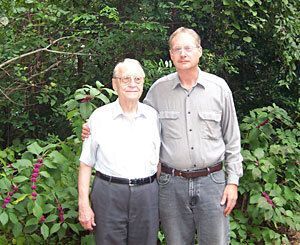
My few visits with Malcolm Damuth were mostly walks in the East Texas piney woods — woods he loved - located near his family home in Cleveland. Too few of us at Houston Audubon had the pleasure of knowing Malcolm — I certainly did not know him well — but all of us were affected by him. Those few walks with him were enough to learn of his deep love of the land, especially the trees, and of his abiding trust in Houston Audubon to be caretaker and conservator of his most valued places.Because of Malcolm and his son, Craig, Houston Audubon owns two exceptional pieces of westernmost Big Thicket habitat: the 165-acre Winters Bayou Sanctuary and the 617- acre Damuth Sanctuary. The sanctuary that bears Malcolm's name is located less than ten miles from where the last specimen of the Ivory-billed Woodpecker in Texas was taken in 1904. These lands were almost completely logged out in the early part of the 20th century, but under the Damuth family care, these properties are replete with a diverse flora, including trees that are 50 to 75 years old—perhaps older.
Malcolm with his son Craig
Malcolm played a less well-known but critical role in HAS history in December, 1991, when he donated $100,000 to help HAS secure threatened migratory bird habitat. At that time, the growing popularity of our sanctuaries at High Island was a serious concern. The main issue was how to protect our small amount of bird habitat from birders. Malcolm's timely contribution sparked a cascade of matching donations, which resulted in a twenty-fold increase in the amount of protected habitat there. Ultimately, the success at High Island fueled our confidence to pursue Bolivar properties and more. Since that time, the Gulf Coast Bird Observatory, which was born of this program, has succeeded in supporting similar conservation projects in four states — Alabama, Mississippi, Louisiana and Texas — as well as Mexico. Without question, the key to the entire program's success was Malcolm's trust and support of Houston Audubon. More importantly, with his contributions Malcolm helped us realize Houston Audubon could be significant land holders and effective land managers.
Maybe you never met this quiet, caring man. But there is a way for us all to get to know Malcolm a little better, a way that will be available for generations to come. Just take an early morning walk in Damuth Sanctuary — down the old logging trail to Tarkington Bayou — and you will see all around you the heart and soul of Malcolm Damuth.
-- Steve Gast
-
 Ellen Red
July 16, 2009
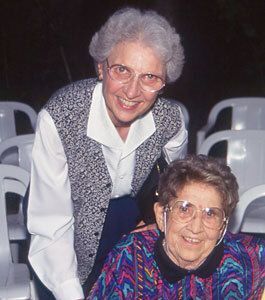
A Purple Gallinule wandered into Ellen Red's yard one day and changed her life. Ellen wasn't a birder then, but she became one that day. When the exotic purple and blue bird walked into her life, it was unlike anything she'd ever seen before, so she went to the only bird book she owned: John James Audubon's 19th-century Birds of America. Turning the pages until she found the painting that identified the mystery bird, she became enthralled with the exquisite bird portraits painted by Audubon. The remainder of the afternoon was spent seeing how many other birds she could recognize in the 500-page collection. It was the beginning of her interest in John James Audubon — and the beginning of her new life as a birder.Ellen with Bessie Cornelius
Ellen's path to Houston Audubon began with the Houston Outdoor Nature Club, which led her to the Ornithology Group and a birding mentor in the person of Margaret Anderson. Another strong influence came into her life in the late 1980s, when she called a man named Al Singleton to inquire about the Houston Christmas Bird Count and he mentioned that his wife Laura Singleton was an avid birder and member of Houston Audubon Society. A friendship with Laura Singleton began that led to years of birding adventures and steadily increasing volunteer work for Houston Audubon. That volunteer work included preparation of the 1987 Annual Report and service on the Board of Directors for four years as the VP for Programs and Field Trips. Many of the successful practices associated with Houston Audubon membership meetings and field trips were established by Ellen. She volunteered regularly for Houston Audubon in a myriad of ways, including preparing its first Directory of Active Members.
The volunteer activity she will probably be best remembered for, however, is the program she presented to HAS membership about John James Audubon's 19th-century visit to Texas. Months of research into Audubon's journals and other historical sources went into preparing for that program, which was received enthusiastically by HAS when she gave it in the late 1990s and later to FeatherFest 2003 participants in Galveston. Audubon's description of Galveston Island and its wealth of birds, his assessment of the culinary worth of various bird species (Bobolink stew was, he said, particularly tasty) and the methods he used to prepare his famous paintings provided her with excellent material. Her painstaking research, talent for writing and endearing style made that a program fondly remembered by all.
Widowed in 2002 after years of marriage to David Red, a Professor of Architecture at Rice University, Ellen was the mother of two children and grandmother of three. She enjoyed a rich life surrounded by family and friends. Among those friends are the good birders who mentored her, such as Margaret Anderson, and those she has mentored, such as Peggy Boston. "Ellen Red made me a deal I couldn't refuse," says Peggy. "She offered to teach me how to bird if I'd help her with a church project." The church project was completed and long forgotten, while Peggy went on to become a Board member of Houston Audubon and Volunteer of the Year in 2003. Mentoring received by Ellen Red continues through others Ellen mentored. It is a chain that began long ago and continues unbroken, sometimes with the help of a Purple Gallinule or John James Audubon, and it constantly provides Houston Audubon with invaluable volunteers, such as HAS Hero Ellen Red.