
© Greg Lavaty
Hudsonian Whimbrel
Numenius hudsonicus
Family: (Scolopacidae) Sandpipers, Phalaropes and Allies
Preferred Habitat: Beaches and mudflats.
Seasonal Occurrence: Uncommon spring and fall. Occasional other seasons.
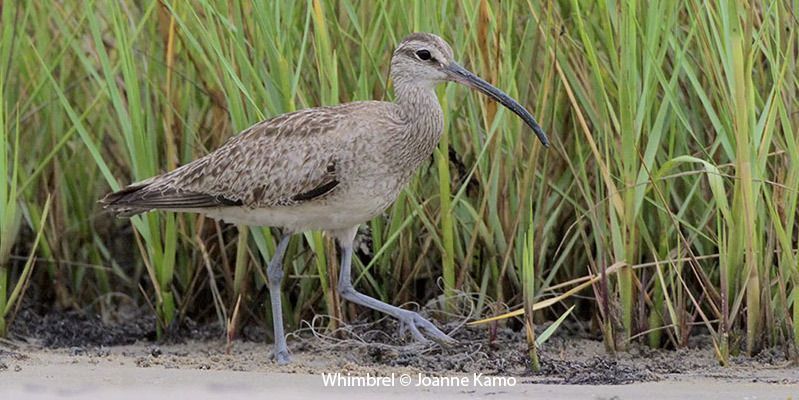
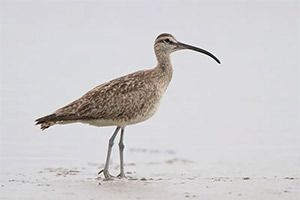
With a long, curved bill designed for catching crabs in their burrows, Hudsonian Whimbrels are a joy to watch on their wintering grounds. The species Whimbrel was recently split into Hudsonian Whimbrel and Eurasian Whimbrel based on genetic differences between American and Eurasian populations. The Hudsonian Whimbrel encompasses the birds that breed and winter across the Americas. Plump in stature, Hudsonian Whimbrels have a uniform brown-and-tan patterned plumage with dark stripes on the crown of their head. Long-billed Curlews have similar coloration, but note the lack of crown stripes, larger size, and much longer bill. Eurasian Whimbrels are rare visitors to the Gulf Coast and have a white rump that Hudsonian Whimbrels lack.
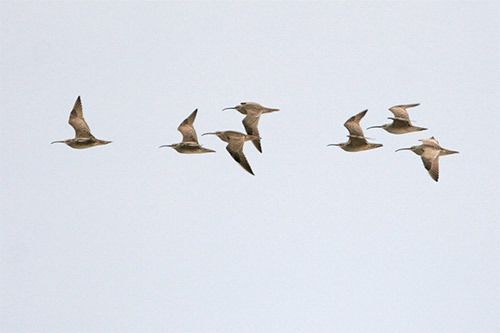
Breeding in subarctic tundra and wintering as far south as the bottom of South America, Hudsonian Whimbrels are impressive long-distance migrants. Pairs nest in loose groups, maintaining territories that they defend from potential predators, including other bird species. Nesting sites are often in wet, grassy lowland areas. The birds dig a nest cup on raised areas on the ground and adorn it with leaves and pieces of lichen. While in the tundra, Hudsonian Whimbrels primarily eat berries from the previous summer, including cranberries and blueberries, and various insects. The birds also rely on berries to fuel their southward migration in the fall. Wintering grounds are widespread, including tidal mudflats along the coastlines of North, Central and South America. In the winter, Hudsonian Whimbrels’ diets shift to a variety of marine invertebrates, including crabs, crayfish and worms.
Hudsonian Whimbrels face threats to their survival at all points in their yearly life cycle. A rapidly warming Arctic is shifting the timing of insect emergence that many birds, including Hudsonian Whimbrels, depend on to feed themselves and their young during the nesting season. Habitat loss across migration routes also threatens the species; as with many long-distance migrants, the presence of productive stopover sites is essential to the survival of Hudsonian Whimbrels during migration. And like other members of the curlew family, Hudsonian Whimbrels were regularly hunted until the early 19th century in the United States and are still a common target on their wintering grounds in countries that lack protections for migratory birds. Hudsonian Whimbrels can be seen on the Texas Gulf Coast in all seasons, but are most common in spring and early fall as the birds migrate to more extreme latitudes. Though less common, Hudsonian Whimbrels have been reported in most winter months around Bolivar Flats Shorebird Sanctuary.
- Colleen McDonough
© Greg Lavaty